To lose a lot of weight (50–100 lb, roughly 23–45 kg) and keep it off, eat about 500 kcal below your maintenance calories, get 1.2–1.6 g of protein per kg of your goal weight, lift weights 2–3 times a week, and log your food and weight consistently. At a safe pace of 0.5–1 kg (1–2 lb) a week, that takes roughly 12–24 months for most people. Recalculate your calories after every 5–10% you lose, judge progress by weekly averages and photos rather than single weigh-ins, and treat maintenance as part of the plan, not the finish line.
How long it takes to lose 50, 70 or 100 pounds
A safe, sustainable pace is 0.5–1 kg (1–2 lb) a week, and no more than about 1% of your body weight a week. Here's what that means for a big goal:
| To lose | At 0.5 kg (1 lb) a week | At 1 kg (2 lb) a week |
|---|---|---|
| 50 lb (23 kg) | ≈ 12 months | ≈ 6 months |
| 70 lb (32 kg) | ≈ 16 months | ≈ 8 months |
| 90 lb (41 kg) | ≈ 21 months | ≈ 10 months |
| 100 lb (45 kg) | ≈ 23 months | ≈ 12 months |
Most people land somewhere between the two columns: faster at the start, when there's more to lose, and slower near the goal. If you plan for 12–24 months, a slow month feels like part of the plan instead of a failure.
The plan: six habits that do the heavy lifting
- Eat about 500 kcal under maintenanceWith a lot to lose, up to 750 kcal can work. Don't go below about 1,200 kcal (women) or 1,500 kcal (men) a day without medical supervision. The calorie deficit guide walks through the math.
- Put protein in every mealAim for 1.2–1.6 g per kg of your goal weight, not your current weight. Protein keeps you full and protects muscle. See the protein guide for a chart.
- Lift weights 2–3 times a weekStrength training keeps your muscle while you're in a deficit, so more of what you lose is fat. That's what changes your shape, not just the number on the scale.
- Walk every dayDaily walking adds up over a week, it's easy to recover from, and it's something you can keep doing for a year or more.
- Log food and weight consistentlyLog every meal you can, by photo, barcode or voice, and weigh yourself at least three mornings a week. Consistency beats precision.
- Sleep 7–9 hoursShort sleep is linked to more hunger and cravings the next day, which makes a deficit much harder to hold.
What to expect, phase by phase
| Phase | What usually happens | What to do |
|---|---|---|
| Weeks 1–4 | The fastest drop. Part of it is water and stored carbs, not fat. | Enjoy it, but don't set expectations by it. It will slow down. |
| Months 2–6 | Steady loss, often 0.5–1 kg (1–2 lb) a week. | Keep logging. Take progress photos every 4 weeks. |
| Months 6–12 | Slower, with the first real plateaus. | Recalculate your calories. Consider 1–2 weeks at maintenance. |
| The last 5–10 kg | The slowest stretch. | Smaller deficit, more strength training, more patience. |
Why weight loss stalls, and what to do
Every long weight loss has flat stretches. Before changing anything, check which of these is behind yours:
- You need fewer calories now. A smaller body burns less. Recalculate your target after every 5–10% you lose.
- Tracking has drifted. Portions grow, bites and drinks go unlogged, weekends get skipped. Log everything for one strict week and compare.
- It's water, not fat. A new workout, a salty meal or the days before a period can hide fat loss on the scale for a week or two.
- It's a real plateau. If your weekly average has been flat for 3–4 weeks, lower your target by 100–200 kcal or add daily steps.
Track more than the scale
Body weight swings 1–2 kg a day from water and salt alone, so single weigh-ins are noisy. These show progress the scale can hide:
- Weekly average weight. Compare averages, not days.
- Progress photos every 4 weeks. Same spot, same light, same clothes.
- Waist measurement. At the belly button, once a month.
- How clothes fit, and what you can lift. Both change even when the scale is stubborn.
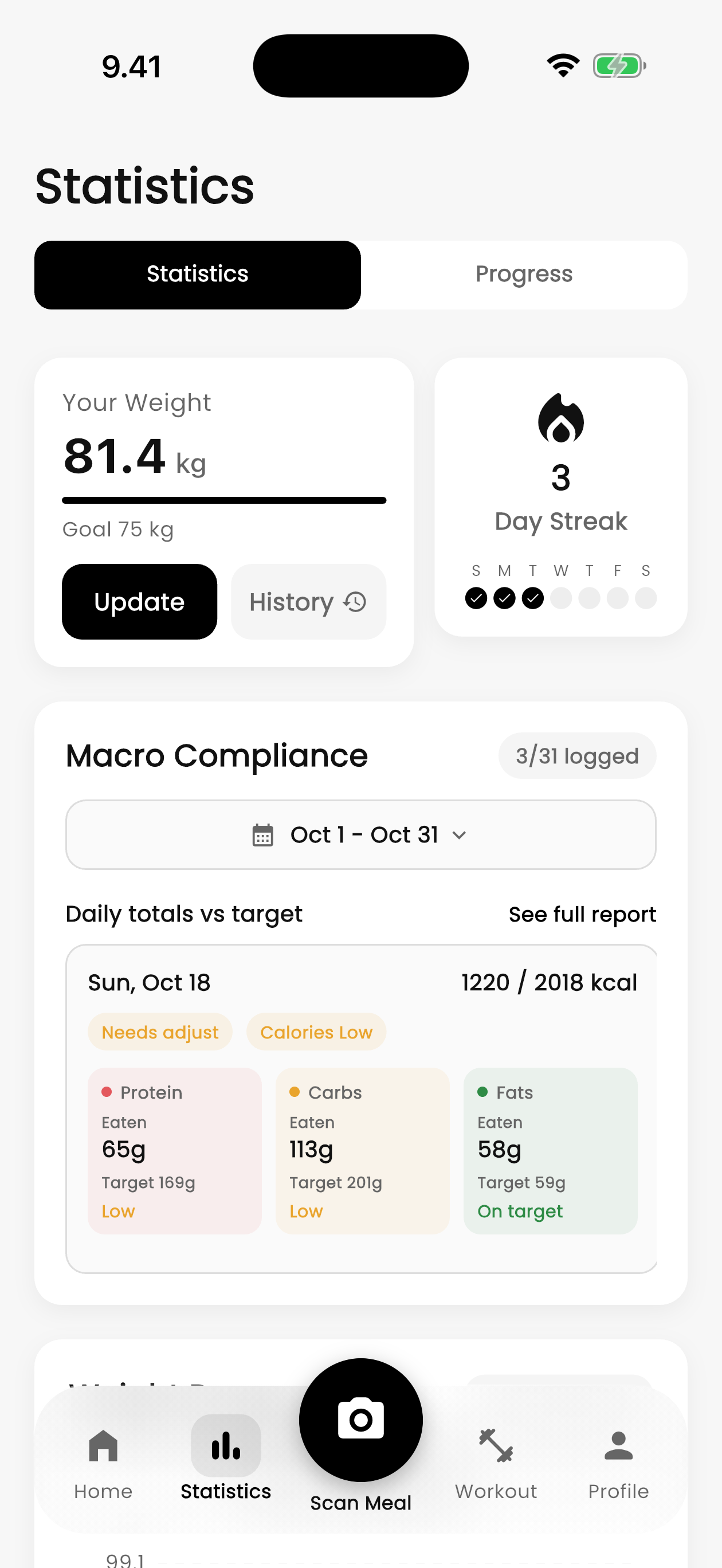
In MealTrack, tap Update under Statistics to log your weight with an optional progress photo. Later, open any entry in your weight history and pick another one to see the two side by side as a before and after.
Keeping it off
Reaching your goal is the start of maintenance, not the end of the plan. Raise your calories by 100–200 kcal a week until your weight holds steady: that's your new maintenance.
- Keep weighing in. Studies of people who kept off large losses, like the US National Weight Control Registry, find most weigh themselves at least once a week and stay active most days.
- Set a trigger range. If your weekly average climbs 2 kg (5 lb) above your goal, go back to logging every meal for a couple of weeks.
- Keep the protein and the weights. They're what keeps the muscle you worked to hold on to.
When to get extra support
Talk to a doctor before starting, especially with a lot to lose. If your BMI is 30 or more, or 27 or more with a condition like type 2 diabetes or high blood pressure, ask about medical options too, including medication. They work best alongside the habits above, not instead of them.
If dieting starts to feel all-consuming, through skipping meals, bingeing, or letting the scale decide your mood for the day, tell a doctor. That matters more than any number in this guide.
Save this guide
The whole guide as a PDF, to read offline or print. It ends with this one-page cheat sheet: every key number on one page, for the fridge or your phone.
 MealTrackCheat sheet
A realistic plan for big weight loss that lasts
- 1Moderate deficit≈500 kcal under maintenance. Not below 1,200 / 1,500 kcal.
- 2Protein every meal1.2–1.6 g per kg of your goal weight.
- 3Lift 2–3× a weekKeeps muscle, so you lose fat and change shape.
- 4RecalculateAfter every 5–10% lost. A smaller body needs fewer calories.
- 5Photos every 4 weeksSame spot, light and clothes. Waist tape too.
- 6Judge weekly averagesFlat for 3–4 weeks? −100–200 kcal or more steps.
 Scan to get the app
Frequently asked questions
How long does it take to lose 90 pounds?
At a safe pace of 0.5–1 kg (1–2 lb) a week, about 10–21 months. Most people land in between: faster at the start and slower near the goal. Plan for 12–24 months.
How many calories should I eat to lose a lot of weight?
Start about 500 kcal below your maintenance calories. With a lot to lose, up to 750 kcal can work, but don't go below about 1,200 kcal (women) or 1,500 kcal (men) a day without medical supervision. Recalculate after every 5–10% you lose. The calorie deficit guide shows how.
Why did my weight loss stop?
Usually because you weigh less and now need fewer calories, or because portions and untracked snacks crept back in. Check 3–4 weeks of weekly averages first. If they're flat, lower your target by 100–200 kcal or add daily steps.
Should I weigh myself every day?
You can, as long as you look at the weekly average rather than single days, because daily weight swings 1–2 kg with water, salt and hormones. If daily weigh-ins upset you, weigh 2–3 times a week and use progress photos too.
Will I have loose skin after losing 50+ pounds?
Possibly. It depends on how much you lose, your age, genetics and how long you carried the weight. Strength training builds muscle underneath, and some people choose surgery once their weight has been stable for a while. No cream reliably prevents it.
This guide is general information, not medical advice. Calorie and nutrient figures are typical values and estimates. Talk to a doctor or registered dietitian before making big changes to your diet, especially if you are pregnant, under 18, or managing a medical condition.